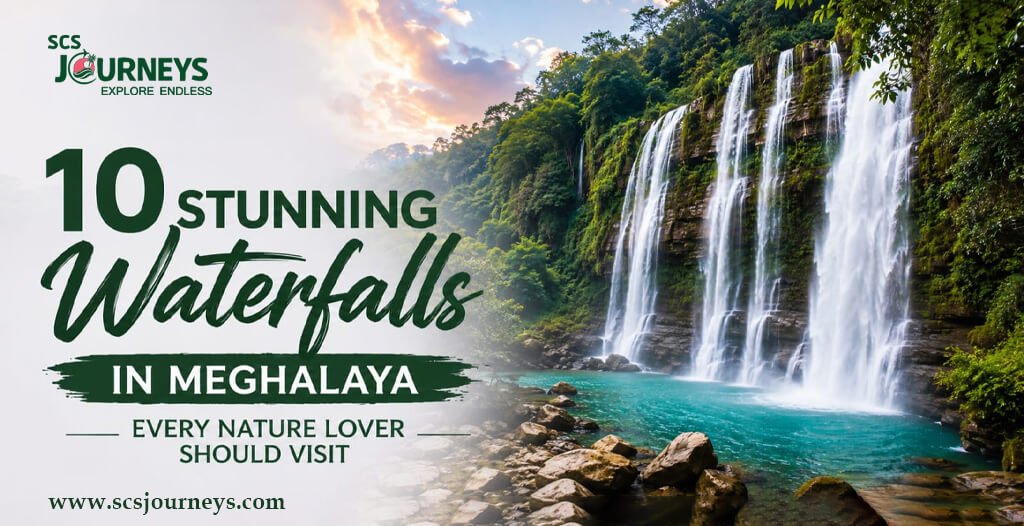
Anyone who has ever passed through the Khasi and Jaintia hills after rainfall will tell you that Meghalaya has not only waterfalls but moods as well. At one turn, you find yourself staring at a slender silver thread cascading from the edge of a cliff. The next turn you take, and the whole hill is crying its heart out in the most poetic way. This is the magic of the waterfalls of Meghalaya, which cannot be ticked on a list but should rather be experienced.
There are some essential things that you must be mindful of before heading for the trip. A number of waterfalls in Meghalaya either run low or completely dry during non-monsoon months so the timing makes a difference. While some waterfalls are merely a short distance from the roadway other falls are not accessible without a proper trek through slippery stone steps. There are few magnificent waterfalls that are also dangerous and therefore, it will be useful to know the safest ones to view. Below is a simple guide describing ten important waterfalls to visit in Meghalaya with details related to the distance, safety, and difficulty levels.
1. Nohkalikai Falls, Cherrapunji
At roughly 340 metres, Nohkalikai is India’s tallest plunge waterfall and the one image most people associate with Meghalaya. It sits about 7 km from Cherrapunji town and is easy to reach by road, with a paved viewpoint and a small entry fee. The legend behind its name – a grieving mother’s tragic jump – adds a haunting layer to the visit. What most articles won’t mention is timing: the falls look genuinely spectacular only from June to September. Visit in the dry winter months and you’ll find a much thinner stream. If photography is your goal, arrive before 9 am, before the mist rolls in and the crowds arrive.
2. Seven Sisters Falls (Nohsngithiang)
Also near Cherrapunji, this is actually a cluster of seven segmented streams falling off the same limestone cliff face near Mawsmai Caves. It’s entirely rain-dependent, so it can vanish almost completely by December. The best window is September to early November, when the monsoon has fed the hills but the sky is clearer for photos, occasionally rewarding visitors with a rainbow at the base. There’s no separate entry fee, and the viewpoint sits right off the highway, making it an easy add-on if you’re already headed to the caves.
3. Krang Suri Falls, Jaintia Hills
Although the Nohkalikai Falls have an amazing height, the Krang Suri Falls fascinate the visitors with its color. The water in the falls is of turquoise color which is equally bright both in the monsoon and dry seasons, and therefore it becomes one of the waterfalls in Meghalaya that can be visited in non-monsoon seasons. The Krang Suri Falls is approximately 90 km from Jowai and a very short hike to the falls through stairs is needed. Swimmers can swim in these falls and it becomes one of those few waterfalls in the region where people can dip into the water instead of watching it from the banks. Therefore, people are advised to hire life jackets that are readily available near the falls as the pool might be deep.
4. Elephant Falls, Shillong
If you’re a traveller in a hurry, then Elephant Falls has probably one of the best locations of the major waterfalls of Meghalaya – just 12 km from Shillong city, with good routes and railings leading you to its three steps. The experience may not be as wild and adventurous as that provided by more remote waterfalls, but it will be great for families, senior citizens, and those who want to visit sites within short time periods. If you aim to beat the crowds of other tourists, you should visit the waterfall on a weekday morning.
5. Wei Sawdong Falls
This three-tiered waterfall near Sohra is a favourite among photographers for its unusual blue-green pools at each level. Reaching it involves a moderate trek down uneven stone steps – not difficult, but not something to attempt in flip-flops after rain, since the path gets genuinely slick. Most blogs mention the beauty and skip the descent details; budget at least 30–40 minutes each way and wear shoes with real grip.
6. Mawsawdong Falls
Located within a few minutes’ walk from the famous Wei Sawdong falls, Mawsawdong falls is one of the Meghalayan falls which remain less crowded. The wide and multi-stepped structure of its rocky cliffs gives it an appearance of staircases, and the 10-minute walk from the road to the falls does not make it difficult to reach.
7. Langshiang Falls, West Khasi Hills
One of the tallest and least visited falls on this list, Langshiang sits deep in West Khasi Hills, surrounded by forest with almost no infrastructure around it. There’s a viewpoint for those who don’t want to trek, and a longer trail down to the base for the more adventurous. Because it’s remote, it’s best visited with a local guide or as part of an organised trip – mobile network is patchy, and the trail isn’t well signposted.
8. Dainthlen Falls
Nohkalikai is closely associated with Dainthlen, which has a story of a giant serpent related to it. The community of Khasi still propagates oral legends on this particular topic. The waterfall of Dainthlen, though not towering very high, is lovely to look at because of the sheer cliffs and foliage that surround it. Since there is a small village nearby, it can provide a better insight into the life of Khasi people than just the view from the platform.
9. Sweet Falls, Shillong
It may sound harmless, but the Sweet Falls near Happy Valley is known for the slippery stones present there, which has made the local officials restrict access to the base of the waterfall. Nevertheless, a viewpoint has been created from which one can enjoy the view of the waterfall. It has been deemed a wise decision on many instances due to the history of accidents caused at the base.
10. Bishop Falls, Nongstoin
Furthest off the usual tourist route, Bishop Falls near Nongstoin rewards travellers willing to go a little out of their way with a largely untouched setting and none of the crowd. It’s a good pick if your trip has already covered the popular Sohra circuit and you want one waterfall that still feels like a discovery.
When Should You Actually Go?
This is where most guides get vague. As a rule: monsoon-fed falls like Seven Sisters and Nohkalikai peak from June to September but can turn muddy and dangerous during heavy downpours, so plan viewpoint visits rather than treks in peak rain. Spring-fed pools like Krang Suri hold their colour and volume well into November and December, making them a better winter choice. If you’re travelling between December and February, lean toward Krang Suri, Elephant Falls, and Wei Sawdong rather than the purely rain-dependent cascades.
A Quick Word on Safety
Algae growth is common on the rocks near Meghalaya’s waterfalls, which makes them extremely slippery even during dry weather conditions. You should remain on designated pathways and stay away from the bases of waterfalls, which have been cordoned off by the authorities; do not attempt to visit any remote waterfalls such as Langshiang without the company of a local guide.
Planning Your Trip
Exploring all ten of these waterfalls independently would entail dealing with long drives, uncertain weather conditions, and villages with poor signage. That’s precisely the reason why most tourists opt for an organized tour instead of taking things on their own. At SCS Journeys, our Meghalaya tour packages are built around the seasons above, pairing the big-ticket falls like Nohkalikai and Elephant Falls with quieter finds like Mawsawdong and Bishop Falls, so you’re not stuck choosing between the famous spots and the hidden ones. Whether you want to stay for three days or for ten days, the planning of the tour will allow you to explore more than just four waterfalls and truly enjoy the “abode of clouds.”
Ready to see it for yourself? Let SCS Journeys plan the perfect route for you – explore Meghalaya and experience these breathtaking waterfalls without the guesswork of timing, permits, or transport.