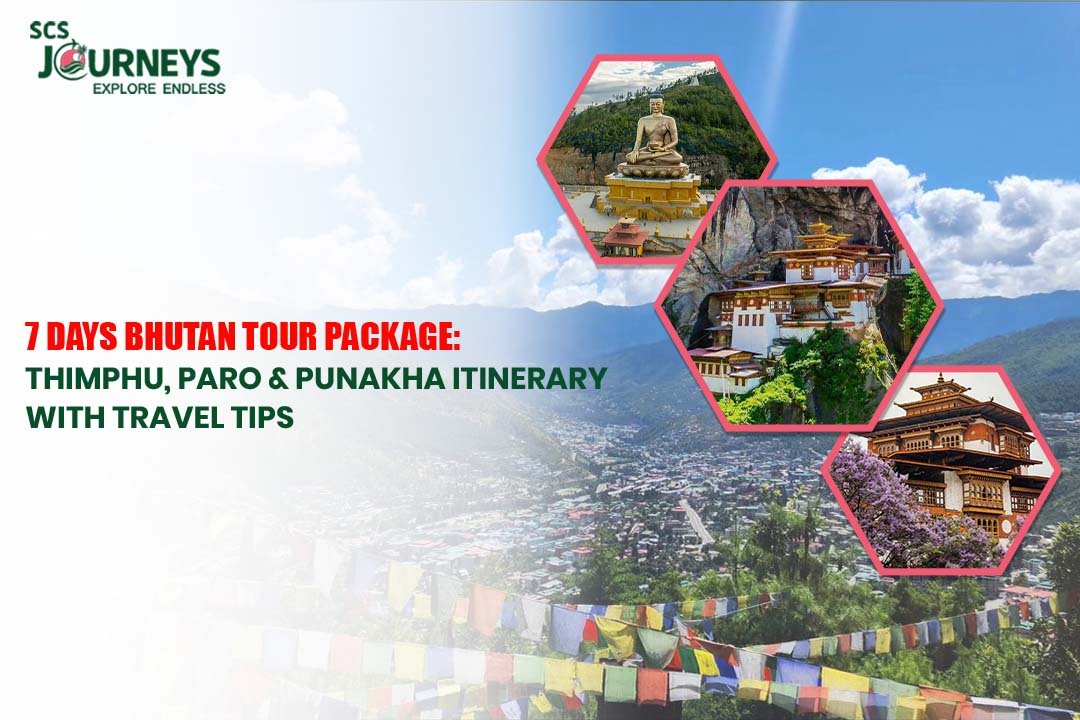
The last Shangri-La on the planet, Bhutan, is a land where national policy is based on making people happy, ancient monasteries are built on precipices, rivers are cold and clear, and it is a place to be. You are in luck because, in case you have been dreaming of a 7-day Bhutan trip plan, the duration of 7 days is just right to take in three of the most spectacular sites of the country, and you do not need to hurry. The guide takes you through the handcrafted 7 Days Bhutan Tour Package visiting Paro, Thimphu and Punakha with the costs, permits, packing guidelines and the most appropriate time to visit the country.
Reasons to Select a 7 Days Bhutan Tour Package?
The optimal length of a Bhutan travel itinerary is seven days. Fewer than five days and you will be in a hurry; more than 10 days and you are probably exhausted with the key attractions as a first-time visitor.
Ideal trip length: 7 days — enough to explore without rushing or burning out.
Must-dos: Morning visit to Punakha Dzong, full Tiger’s Nest hike (5–6 hrs), Thimphu weekend market, cozy evenings with local Ara (rice spirit).
Best for Siliguri travellers: Phuentsholing border is just ~170km away — easy and budget-friendly crossing.
Recommended operator: SCS Journeys (Siliguri) — handles permits, accommodation & transfers end-to-end.
Your 7-day Bhutan Tour Itinerary
Day 1 – Paro: Himalayan Foothold
Siliguri-Phuentsholing-Paro (5-6 hrs drive) or fly to Paro International Airport.
- Cross the Phuentholing border gate, go through immigration and get your Bhutan Permit.
- Failing to ascend to the skies through pine-treed gullies.
- Check in at Paro Hotel and take a shower.
- Evening walk along Paro Chhu (river), and visit the street market
- Welcome dinner including Ema Datshi – the national dish of chilli and cheese curry in Bhutan.
Travel Notice: Paro is at an elevation of approximately 2,200 m. Relax on arrival day to adapt. Consume a lot of water and do not overwork.
Day 2 – Paro Assisted Tour: Ruins, Relics and River Views
Whole day in Paro Valley.
- Visit Rinpung Dzong (Paro Dzong) – a grand fortress-monastery that overlooks the valley.
- Visit the National Museum of Bhutan (Ta Dzong) – masks, armour, thangkas, and natural history
- Stroll over the historic cantilever bridge at Nyamai Zam.
- See Drukgyel Dzong ruins – a fort made to honour triumph over Tibetan invaders.
- When the sky is clear, the spot Mount Jhomolhari (7,326 m) can be seen glittering in the distance at Drukgyel.
Indulge yourself with a traditional Bhutanese hot stone bath (Dotsho) – most soothing after travelling.
Day 3 – Tiger Nests Monastery: Bhutanian Icon
Seek- Taktsang Palphug Monastery Hike.
- Morning light still pale, begin climbing by 8 if possible. Starting sooner helps avoid the heat later on.
- Starting out at the base, the path to Paro Taktsang stretches about 10 kilometres there and back. Rising nearly 900 meters above where you begin, the climb gains serious height through rocky trails.
- Photographers often settle here because light and landscape align just right. The air feels still, the frame comes together. From this height, the country spreads out without clutter.
- Up high at 3,120 meters sits the Tiger’s Nest, built back in 1692 on rugged cliffside stone. While you’re there, step through four holy temples tucked into the mountainside.
- Grab a bite at the café before heading out – a packed meal works too. Further along, it’s two or three hours on foot.
- Later in the day, guests might stop by Kyichu Lhakhang – dating back to the 600s, it ranks among Bhutan’s holiest sites. This quiet temple stands centuries deep in tradition, its walls holding whispers of early Buddhist practice.
Day 4 – It is Paro to Thimphu: The Capital in The Clouds.
- 1.5 A long stretch behind the wheel leads to Thimphu. Morning light hits temple roofs during a brief walk through old town lanes.
- Thimphu greets you upon arrival – this capital sprawls across a wide, leafy basin near 2,350 meters. Not a city that shouts, it sits quietly among hills, soaked in calm.
- A walk leads up to Tashichho Dzong – home of Bhutan’s government, plus where senior monks gather. A giant statue stands tall above Thimphu, its gold-covered frame catching the light.
- A visit unfolds at the National Textile Museum – home to Bhutan’s weaving roots, where threads tell stories of Gho and Kira. Cloth here carries history, not just pattern
- Thimphu Weekend Market (Friday- Sunday): produce, handicraft and dried yak cheese biscuits.
- Later on, head down Norzin Lam – this place sits right at the heart of town – for coffee spots, reading corners, while catching faces passing by. A bench waits somewhere under soft light where time slows just enough.
Day 5 – Thimphu to Punakha: Valley of Fertility and Flowers.
Drive 3 hrs through Dochula Pass (3,100 m).
- High up at Dochula Pass, pause awhile. One hundred eight small white towers stand in quiet rows. Colourful clothes flutter from lines strung between poles. When skies open wide, mountain tops appear – ten of them, far off but sharp against blue.
- Up near the mountain pass sits Druk Wangyal Lhakhang – its walls lined with vivid scenes from Bhutan’s recent past. Each image unfolds like pages torn from time, showing moments most still remember.
- Down in the warm stretch of Punakha valley sits Bhutan’s former winter seat. This lowland pocket held power when cold months drove life southward.
- Punakha Dzong sits where the Pho Chu meets the Mo Chu, a spot many find more striking than any other dzong across Bhutan.
- Over the Mo Chhu river stretches a 180-meter-long suspension bridge, decorated with bright prayer flags fluttering in the wind.
- Beneath the hills, paths cut across flooded rice plots lead to Chimi Lhakhang – known for blessings tied to childbirth. This sacred site sits quietly, reached only on foot, where visitors step past golden stalks swaying in the wind. Stories follow those who come here, whispered like prayers under breath. Each stride forward moves one closer not just to walls and prayer flags but something older, rooted deep in soil and belief.
- Pink jacaranda trees light up Punaka valley in February, their blooms mixing with soft peach tones across the hills. Come March, the air stays painted with colour as the land holds onto spring’s glow.
Day 6 – Back to Paro and Punakha Leisure.
Back toward Paro on a half-day trip through Punakha, passing by Thimphu along the way.
- Morning White Water Rafting on the Mo Chhu River Grade One to Three Beginner Friendly Seasonal
- The footpath climbs through flooded fields, then steps rise toward a shrine perched high above the valley floor. A half hour of walking brings you there, past terraced plots where farmers bend under sunlit skies.
- Lunch in Punakha. Heading toward Paro next – roughly four hours including a pause at Dochula Pass – then returning by road.
- As night falls, share a final meal in Paro. Try Red Rice served with Shakam Paa – dried beef quickly cooked with heat and spice. This dish carries warmth through each bite.
- Later on, pick up fabric pieces, hand-carved bowls meant for quiet moments, or small bundles of smoke made by local makers.
Day 7 – Leaving
Phuentholing to Paro Airport
- Morning breaks. Over the Paro valley, sunlight spills into the lowlands. The Zuri Dzong stands still, catching its first glow. Gold spreads slowly across stone and slope.
- Permit cleared at last. Through the door goes the check, then a refresh alongside directions.
- Travel begins on the route toward Phuentholing, then returns through Siliguri. Another path leads from Paro Airport where the flight waits ahead.
- Back at your door when dusk settles, arms may be full of woven things from Bhutanese hands. Memories stick around long after the path back ends.
What Does a 7 Days Bhutan Holiday Package Cost?
Bhutan follows a Sustainable Development Fee model designed to support its world-class healthcare, free education, and conservation programmes. Below is an approximate cost breakdown for Indian travellers: Here is the cost breakdown table:
| Component | Approx. Cost (INR) |
| Bhutan Sustainable Development Fee (Indian nationals) | ₹1,200 per person per day |
| Accommodation (3-star, twin sharing, 6 nights) | ₹12,000–₹18,000 approx per person (Included in package) |
| All meals (breakfast, lunch, dinner) | Included in package |
| Licensed Bhutanese guide (mandatory) | Included in package |
| All transfers and transport | Included in package |
| Monument entry fees | Partially included |
| Total Estimated (per person) | ₹35,000–₹55,000 |
Entry Permit Requirements
Indian nationals will not need a passport to travel to Bhutan; a valid Voter ID card is accepted at the land border. The next permits are, however, obligatory and are organized by your licensed tour operator:
Entry Permit: This is acquired at the immigration office in Phusentholing or the Airport in Paro on arrival. This is done beforehand by your tour operator.
Route Permit: To be able to travel on the road outside Thimphu and Paro – necessary to reach Punakha and other valleys. Issued via your operator.
Area Permit: Only required in the restricted areas, such as the Haa Valley. This is not necessary in a typical 7-day itinerary visiting Bhutan that includes Paro, Thimphu and Punakha.
Sustainable Development Fee: INR 1,200 per individual per day for citizens of SAARC, including Indians. Included in the 7 Days Bhutan Tour Package as paid through your tour operator.
Time to Visit The Land of Thunder Dragon
Bhutan is blessed with four seasons, and each has a unique taste of travelling.
Spring (March -May). Rhododendrons blossom along the hills. The festival of Paro Tshechu is in April, the skies are clear, and the days are warm. It is peak season; book early.
Autumn (September-November): The air is crystal clear during the post-monsoon period, and mountain views are the best of the year. The Thimphu Tshechu festival is usually held in September. The valleys are painted with harvest gold.
Winter (December -February) is chilly yet breathtaking. Crowds are reduced, and package rates are lower. The black-necked cranes, which are rare, pay a visit to the Phobjikha Valley and the spectacular Punakha Tshechu in late February or early March.
Monsoon (June- August): It is accompanied by rich and heavily greened landscapes. Yet, due to heavy rains, road travel and outdoor events can be disturbed.
What to Carry in Your 7-Day Bhutan Travel Package
- Layered clothing – temperatures change drastically between warm valley towns and cold mountain passes.
- Trekking shoes (no bargain when it comes to the Tiger Nest trek)
- Thermal inner garments, even in spring and autumn, as well as a warm jacket.
- Small-scale clothes when visiting dzongs and temples, covering knees and shoulders, are expected everywhere in a religious place.
- Sunscreen and UV-protection sunglasses – the sun is much more powerful at high altitudes than at sea level.
- Personal medicines and a small first-aid kit – there are a few pharmacies outside of Thimphu.
- Cash in Indian rupees – This is acceptable in the whole of Bhutan; ATMs available in Thimphu and Paro, but with backup cash.
- Power bank – electricity may not be available in small towns and guesthouses.
A handy day pack to use on treks and half-day tours.
Currency Note: Bhutan has a 1:1 pegged currency based on the Indian Rupee called Ngultrum (BTN). INR 500 and INR 2,000 bills might not be accepted all over the place – carry lower bill denominations.
Frequently Asked Questions (FAQs)
Yes. The distance between Siliguri and Phuentsholing (India-Bhutan border) is about 170km, and the road has a time span of about 3.5 or 4 hours by car. Upon completion of immigration, you bypass Phuentsholing and enter Bhutan by road.
Absolutely. This 7-day Bhutan itinerary gives a comfortable cover of Paro with Tiger Nest, Thimphu and Punakha, which are the three most important sites in the west of Bhutan. You will not be in a hurry to hike or sightsee and enjoy the culture.
Indian nationals will be allowed entry to Bhutan with a valid passport or a Voter ID card issued by the government. It is advisable to have a passport that will enable a hassle-free process, especially when flying to the Paro International Airport.
Since September 2022, Bhutan has levied an SDF on all tourists. The present rate charged is about INR 1,200 per person per day to Indian and other SAARC nationals. This is a direct fee to fund the free healthcare, education and environmental conservation programmes of Bhutan.
Travel with SCS Journeys to plan your Bhutan Journey
The 7 Days Bhutan Tour Package is not just a vacation; it is a reset. It is watching monks arguing over scripture in a courtyard. The inhaling of pine-scented mountain air will fill your heart. You can be travelling as a couple, a family, or a solo explorer, but Bhutan, in some way, will be with you much longer than when you get home.
SCS Journeys, located in Siliguri, focuses on tailor-made Bhutan travel. It involves all the arrangements, like a permit to enter the country, logistics of the Tiger Nest, etc.
Call today to have a personal Bhutan travel plan of 7 days made around your dates, budget and the way of travel. Visit SCS Journeys.