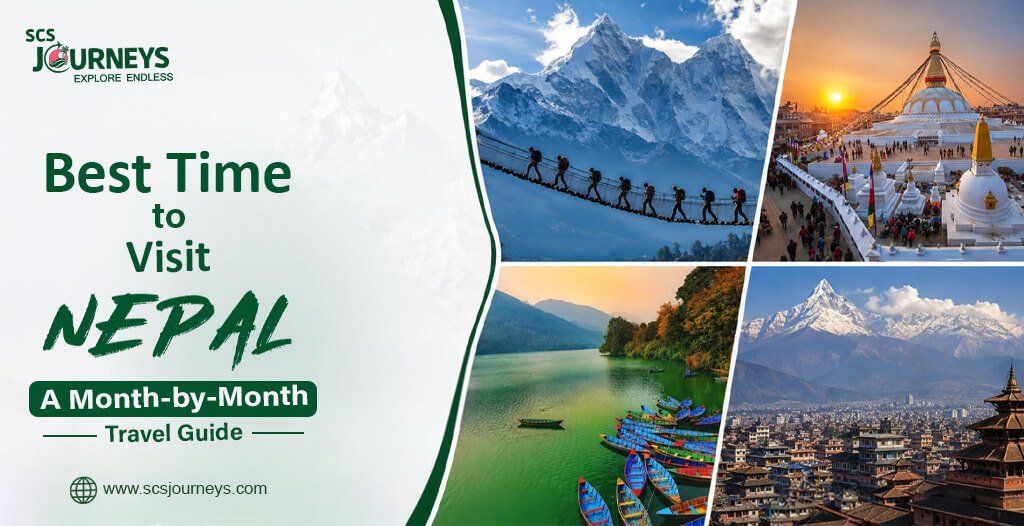
Search “best time to visit Nepal” and you’ll find plenty of guides listing average temperatures and the usual spring-versus-autumn debate. They’re not wrong – but most are written for travelers flying in from Europe or North America. They rarely mention what the journey looks like if you’re coming overland from India, or how to quickly match the right season to your specific kind of trip.
As a travel agency in Siliguri, SCS Journeys sends travelers into Nepal all year round, often overland through the Kakarbhitta border rather than by air. This article contains information that larger blogs don’t share: summarizing the impact of seasons on travel plans and providing a quicker method to help you make your travel decision.
Best Time to Visit Nepal: The Short Answer
If you only read one section, read this one. The best time to visit Nepal is generally late September to November and March to April – the post-monsoon and pre-monsoon windows when skies are clear, temperatures are comfortable, and both mountain and lowland regions are at their most accessible. But that’s only half the story if you’re planning the practical side of the trip.
What Most Guides Miss: The Overland Route from India
Knowing when to visit Nepal isn’t just about the calendar – it’s about how the season affects your actual route. If you’re traveling from Siliguri, Darjeeling, or anywhere in Northeast India, you’re likely crossing the border at Kakarbhitta and driving through to Pokhara or Kathmandu rather than flying. Weather affects this route very differently than it affects flights:
- Monsoon (June–August): The route’s toughest stretch. Heavy rain raises landslide risk on the hill roads beyond the border, and journey times can stretch unpredictably. Build in buffer days and check road advisories before departure.
- Winter (December–February): Roads are generally clear, but early-morning fog around the Terai and border areas can delay departures. Afternoon starts tend to move more smoothly than early mornings in peak fog season.
- Spring and autumn (March-May, September–November): The route is at its most reliable – dry roads, good visibility, minimal delays. It’s also when overland traffic peaks, so border queues can build, especially around Dashain and Tihar.
This is a detail almost none of the flight-focused guides touch on, but it can make or break your itinerary if you’re not flying.
Match the Season to Your Trip Type
Instead of going through the weather of 12 months, this is a quick way to choose the right time:
- For trekkers (Everest, Annapurna, and Langtang), the ideal months for the tour are October to November or March to April for good views and safe routes.
- For wildlife enthusiasts (Chitwan, Bardia), the ideal months are October to April due to the dry grasslands.
- For people who love culture (Kathmandu, Bhaktapur, Patan), they can visit the temples and places almost all around the year, but the best month to visit is October during Dashain and Tihar festival in Nepal.
- For budget travelers, one must plan their visits in shoulder months (late February, early March, June) as they will pay comparatively less for airfare, permits, accommodation, and travel on the less congested routes.
- For honeymooners and first-timers, the best months to visit Nepal are March and April due to good weather and blooming flowers without the crowd during October.
- For Rain-shadow travelers (Upper Mustang, Dolpo), one can visit Nepal between June to August as the regions are apt for trekking even during the monsoon season.
Month-by-Month Breakdown
Here’s a fuller look at what to expect throughout the year, so you can match your dates to the conditions rather than guessing.
January: The coldest month, with clear skies but sub-zero nights at higher elevations. High passes can be snowbound, so this suits lowland treks, Chitwan safaris, and cultural sightseeing. Crowds are thin, and the overland road from Siliguri is generally clear, though early fog can delay morning departures.
February: The temperatures rise, and the first buds of the rhododendrons bloom. The shoulder season is more pleasant than January and cheaper in terms of prices for flights and land travel.
March: Spring flowers on the routes to Annapurna and the Poon Hill. Temperatures rise and traffic on the trails starts to grow. It is the most reliable time of overland travel from India.
April: This is one of the best months of trekking; the only other great time is October. It is the clearest month, which means excellent visibility.
May: Still a strong trekking month, though temperatures rise and late-month haze can reduce visibility as monsoon clouds build. Higher routes stay pleasant even as the lowlands get warmer and humid.
June: June is the time when monsoon season arrives, and during this time, rain usually falls during the afternoon and evening hours. The mornings are cool but trails will be muddy and leeches will appear at lower elevations. However, regions in rain shadow such as the Upper Mustang are dry. It is also the time when landslip risk increases while travelling through overland routes.
July: July is one of the rainiest months, so normal trekking routes are better avoided during this time. It is, however , a good time to explore the cultural side of Kathmandu, Bhaktapur and Patan as the number of tourists is drastically reduced.
August: August is almost like July with rain still pouring down but at least festivals such as Janai Purnima and Gai Jatra provide some energy to the Kathmandu Valley. Towards the end of the month, the rain is gradually subsiding.
September: September is a transitional month. Early September still has rain but by mid-late of this month the skies clear up and the landscape becomes lush and green.
October: This month is known to be the best month of Nepal. It is said that the weather has the most perfect atmosphere, making the visibility for mountain treks better. Dashain and Tihar fall in October each year and many travelers choose this month for visiting Nepal, especially since it is the high season and the crossing of Kakarbhitta is busy.
November: Many aspects of October weather are observed still, but the nights get colder and crowds of travelers are less. The month is still considered a very high trekking season as well as a good month for overland tours.
December: The winter is back. Higher trekking routes are closed due to the snow, but traveling in the lower areas and Kathmandu is still great.
What to Pack, Season by Season
Proper packing is equally important as proper choice of the right time of year. For spring and fall expeditions, pack appropriately for cool mornings and hot afternoons, along with good UV protection in the high altitude environment. In case of traveling during the monsoons, pack waterproof layers, quick-dry clothes, and leech socks while traveling through the low elevation forests.. Overland travelers crossing at Kakarbhitta in winter should also pack for fog delays – a flexible schedule and warm layers for an early start go a long way.
Plan It With Local Knowledge
Being aware of the best time to go to Nepal is only the first stage in planning your journey. The other parts of this process involve figuring out how the season impacts your own route, area, and means of transport. As a travel agency in Siliguri that has hands-on experience working the overland route to Nepal, SCS Journeys is your best option to help you plan your journey according to real road conditions, border traffic, and climate, rather than only average seasonal indicators.
If you would like to plan your Nepal trip the right way, Get in touch with SCS Journeys to gain help in choosing travel dates, itinerary, and route.